Introduction
Starting a business does not always require a large team, expensive office, or significant upfront investment. In 2026, technology is making it easier for entrepreneurs to launch specialized businesses and serve customers more efficiently.
Artificial intelligence, digital commerce, cybersecurity, and online services are creating new opportunities for small businesses. Recent U.S. Census Bureau data shows that business use of AI has remained around 17%–20%, while adoption is higher in several knowledge-intensive sectors.
That does not mean every new business will succeed. The strongest opportunities are usually built around a real customer problem, a clear service, and a market that is already showing demand.
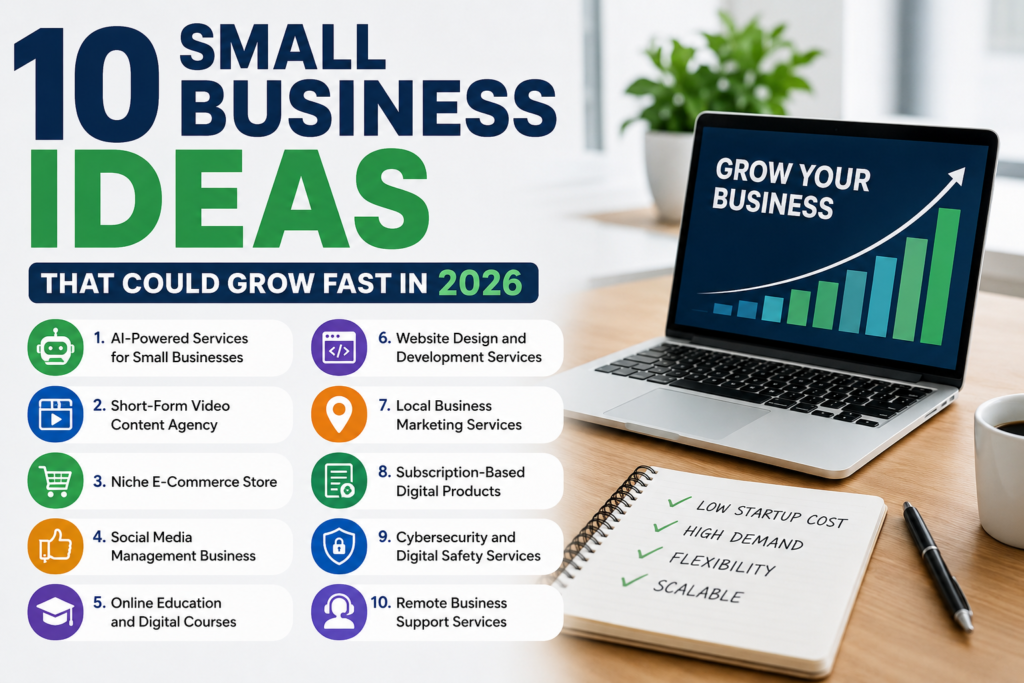
Here are 10 small business ideas worth watching in 2026.
1. AI Implementation Services for Small Businesses
Many small businesses know they should be using AI, but they do not always know where to begin.
This creates an opportunity for businesses that help companies introduce AI into everyday operations. Services could include workflow automation, customer-service systems, document processing, research, or marketing assistance.
According to the U.S. Census Bureau, businesses are already using AI across functions such as sales and marketing, strategy and business development, and IT.
The opportunity is not simply selling an AI tool. It is helping a business understand how to use technology to solve a specific problem.
2. Short-Form Video and Social Media Services
Small businesses need attention online, but many owners do not have the time or skills to consistently create content.
A specialized social media service can help businesses create short videos, manage content calendars, write captions, and turn existing business material into engaging posts.
Social commerce and social-first retail continue to be important trends for small businesses in 2026.
A strong advantage in this market is specialization. Instead of trying to serve everyone, a company could focus on one group, such as restaurants, real estate businesses, local retailers, or professional services.
3. Niche E-Commerce Businesses
Starting another general online store can be difficult. A more promising approach is to focus on a specific audience and a specific problem.
For example, an entrepreneur might build a store around a particular hobby, professional need, lifestyle, or underserved customer group.
The goal is not to compete with the biggest retailers on everything. It is to become highly relevant to a smaller audience.
Small businesses are increasingly using digital platforms, social commerce, and niche positioning to compete with larger companies.
4. Cybersecurity Services for Small Businesses
As more small businesses depend on cloud software, online payments, mobile devices, and digital customer information, cybersecurity becomes increasingly important.
Many smaller companies do not have dedicated security teams. That creates demand for practical services such as security assessments, employee awareness training, account-security reviews, and basic security management.
Cybersecurity is particularly relevant because small businesses often have limited resources while still handling valuable business and customer information. Current small-business trend research identifies cybersecurity as an increasing priority.
For entrepreneurs with appropriate technical knowledge, this can become a specialized and valuable service business.
5. Business Automation Services
Businesses often lose hours every week to repetitive tasks.
Scheduling appointments, organizing customer information, sending routine emails, preparing reports, and moving information between different systems can often be streamlined with software.
That creates an opportunity for small companies that specialize in business automation.
The interesting part is that automation does not necessarily require building complicated software from scratch. A service provider can help businesses connect the tools they already use and create simpler workflows.
Small businesses are increasingly relying on software to operate with leaner teams.
6. Local SEO and Online Visibility Services
A local business can have an excellent product and still struggle if customers cannot find it online.
Local SEO services can help businesses improve their online visibility, organize business information, create useful content, and build a stronger presence in local search.
This opportunity is especially relevant for businesses that depend on customers in a particular city or region.
Instead of offering generic SEO, entrepreneurs can specialize in one industry or geographic market. A focused service can be easier to explain and differentiate.
7. Specialized Business Education and Training
The business world changes quickly, and employees and entrepreneurs constantly need new skills.
That creates opportunities for specialized educational businesses offering courses, workshops, guides, or training programs.
Possible areas include:
- AI literacy
- Digital marketing
- Business technology
- Sales skills
- Productivity
- Entrepreneurship
- Cybersecurity awareness
- Data analysis
The key is to solve a specific learning problem rather than creating another broad course about “business.”
8. Sustainable and Reusable Products
Sustainability continues to influence how some consumers and businesses make purchasing decisions.
A small company can explore products designed around reuse, reduced waste, repair, or more efficient consumption.
However, successful businesses in this space need to offer more than an environmental message. Customers still care about quality, price, convenience, and usefulness.
That is why the strongest sustainable businesses combine a practical product with a clear environmental benefit.
9. Digital Customer Experience Services
A customer’s experience with a business increasingly happens through digital channels.
Websites, online booking systems, customer-service chat, email, mobile experiences, and online purchasing all influence how people perceive a company.
A small agency can specialize in improving these experiences for businesses that do not have their own digital teams.
The opportunity is particularly interesting because customer experience is not just a design issue. It can affect whether a customer completes a purchase, returns later, or recommends the business.
10. Data and Business Intelligence Services
Businesses collect more information than ever, but having data is not the same as understanding it.
Small companies can provide services that turn business information into useful reports and decisions.
For example, a service might help a company understand:
- Which products sell best
- Where customers come from
- Which marketing channels perform well
- When demand changes
- Where operational costs are increasing
- Which customers return most often
As businesses adopt more digital tools, the ability to organize and interpret information becomes increasingly valuable.
What Makes These Small Business Ideas Interesting in 2026?
One common theme connects many of these opportunities: businesses are trying to do more with limited resources.
AI and software are helping companies automate tasks, improve productivity, and operate with leaner teams. At the same time, businesses still need human expertise to decide what should be automated and how technology should be used responsibly.
That creates an important distinction.
The best small business ideas are not necessarily the businesses using the newest technology. They are businesses that use technology to solve a problem customers already have.
How to Choose the Right Business Idea
Before starting, ask yourself five questions:
1. Is there a real problem?
A business becomes easier to build when customers already recognize the problem you’re solving.
2. Who is the customer?
“Everyone” is usually not a good target market. A clearly defined customer makes marketing and product development easier.
3. Can you offer something different?
Your advantage could be specialization, better service, faster delivery, deeper expertise, or a better customer experience.
4. Can the business start small?
A business that can be tested with a small number of customers gives you an opportunity to learn before making larger investments.
5. Can it grow?
Look for a model where you can eventually serve more customers without increasing costs at exactly the same rate.
Final Thoughts
The most promising small business ideas in 2026 are closely connected to changes already happening in the economy. AI adoption, digital commerce, cybersecurity, automation, and specialized online services are creating opportunities for entrepreneurs who understand what customers actually need.
But a trending idea alone is not enough.
A successful business usually starts with a simple question:
What problem can I solve better, faster, or more conveniently for a specific group of people?
If you can answer that clearly, even a small business can have room to grow.
SEO details for your website
Focus keyword: small business ideas
SEO title: 10 Small Business Ideas That Could Grow Fast in 2026
Suggested URL: /small-business-ideas-2026/
Meta description: Discover 10 small business ideas that could grow fast in 2026, from AI services and automation to e-commerce, cybersecurity, SEO, and digital services.
Suggested secondary keywords:small business ideas 2026, business ideas, best small business ideas, online business ideas, small business trends 2026, business opportunities 2026
Suggested category: Business
11. Virtual Assistant Services
As more entrepreneurs and small companies operate remotely, administrative work can become difficult to manage.
A virtual assistant can help with tasks such as:
- Managing calendars
- Responding to emails
- Customer support
- Data organization
- Appointment scheduling
- Basic research
- Social media management
The opportunity becomes stronger when the service is specialized. For example, instead of simply offering “virtual assistance,” you could focus on helping real estate agents, online stores, consultants, or small agencies.
12. Website Design and Maintenance
A professional website remains important for businesses that want customers to find them online.
However, many small businesses do not need a complicated website. They need something that loads quickly, works well on mobile devices, looks trustworthy, and makes it easy for customers to contact them.
This creates opportunities for entrepreneurs who can provide affordable website design and ongoing maintenance.
A recurring maintenance service can also create more predictable revenue than building websites one customer at a time.
13. Online Reputation Management
Before contacting a business, customers often look at its online presence.
Reviews, search results, social media profiles, and business information can influence whether someone decides to trust a company.
An online reputation service can help businesses monitor reviews, respond professionally to customers, maintain accurate business information, and identify recurring customer complaints.
The most valuable approach is not simply trying to make a company “look good.” It is helping the business understand what customers are saying and improve its service.
14. Mobile Car Care Services
Convenience is becoming increasingly valuable to consumers.
Instead of customers taking their vehicles to a traditional location, mobile service providers can travel to the customer.
Depending on local regulations and skills, opportunities can include:
- Mobile car cleaning
- Basic maintenance
- Detailing
- Tire services
- Vehicle inspection assistance
The advantage is simple: the service comes to the customer.
A business model based on convenience can work particularly well when it serves a clearly defined local area.
15. Home and Property Maintenance Services
Property owners regularly need help with maintenance and repairs.
Small businesses can specialize in services such as cleaning, landscaping, painting, appliance maintenance, or general property care.
One advantage of this category is repeat demand. A satisfied customer may need the same service again or recommend the company to others.
Entrepreneurs can also build packages around recurring maintenance rather than relying entirely on one-time jobs.
16. Personalized Online Consulting
People and businesses increasingly look for specialized knowledge rather than general information.
If you have genuine expertise in an area, online consulting can turn that knowledge into a service.
Examples include:
- Business consulting
- Marketing consulting
- Technology consulting
- Career guidance
- Financial education
- Productivity consulting
The important part is positioning. A consultant who says “I help businesses” is difficult to differentiate.
A stronger message might be:
“I help small online retailers improve their digital customer experience.”
Specific problems attract specific customers.
17. Subscription-Based Services
Subscription businesses are not limited to software.
Small businesses can create recurring subscriptions around products or services that customers regularly need.
Examples include:
- Educational content
- Business resources
- Digital templates
- Specialty products
- Maintenance services
- Professional newsletters
The advantage is that subscriptions can create recurring relationships instead of requiring a new sale every time.
However, customers need a clear reason to continue paying. A subscription should consistently provide useful value.
18. Digital Products for Businesses
Digital products can be attractive because they can be created once and sold repeatedly.
Examples include:
- Business templates
- Spreadsheet tools
- Presentation templates
- Marketing resources
- Checklists
- Educational guides
- Industry-specific documents
The key is solving a specific problem.
Instead of creating a generic “business template,” you could create something designed specifically for a particular type of business.
The more specific the customer and problem, the easier it can be to communicate the product’s value.
19. Translation and Localization Services
Businesses increasingly communicate with customers across different countries and languages.
This creates opportunities for people with strong language skills to provide translation and localization services.
But localization involves more than translating words. It can include adapting:
- Marketing messages
- Websites
- Product descriptions
- Customer communications
- Cultural references
Businesses entering new markets may need content that feels natural to local customers rather than content that simply sounds translated.
20. Senior and Family Support Services
As populations age in many countries, families increasingly need reliable services that make everyday life easier for older adults.
Depending on local laws, qualifications, and regulations, opportunities can include non-medical assistance such as transportation, errands, household support, companionship, or technology assistance.
This type of business depends heavily on trust and reputation.
For that reason, professionalism, reliability, background checks where appropriate, and clear communication can be more important than aggressive marketing.
Which Small Business Ideas Have the Most Potential?
There is no single business idea that is guaranteed to succeed in 2026.
However, several patterns stand out.
Businesses that save time
People and companies are willing to pay for services that remove repetitive or inconvenient tasks.
Businesses that specialize
A company serving a specific audience can often communicate its value more clearly than a company trying to serve everybody.
Businesses that improve digital presence
Companies still need websites, content, search visibility, customer support, and effective digital experiences.
Businesses that combine technology with human expertise
AI can make many tasks faster, but businesses still need people who understand customers, industries, communication, and decision-making.
Businesses built around recurring needs
Services that customers need regularly can potentially create more stable revenue than businesses dependent entirely on one-time purchases.
How to Test a Business Idea Before Investing Too Much
One of the biggest mistakes new entrepreneurs make is spending heavily before finding out whether customers actually want the product or service.
A better approach is to test the idea first.
Start with a simple version of the service.
Find a small group of potential customers.
Ask them about the problem.
Offer a practical solution.
Then pay attention to what happens.
If people are willing to pay, recommend the service, or come back, you have stronger evidence that the idea may have potential.
If nobody is interested, that information is valuable too. You can change the offer before investing more money.

The Real Opportunity Behind Small Business Ideas in 2026
The most interesting opportunities are not necessarily completely new industries.
Sometimes the opportunity comes from taking an existing service and delivering it in a faster, simpler, more convenient, or more specialized way.
For example, a traditional service could become more competitive by adding online booking. A consultant could use AI to reduce administrative work. A local company could use content marketing to reach customers beyond its existing network.
This is why entrepreneurs should look beyond trends.
Instead of asking:
“What business is popular right now?”
Ask:
“What problem are people still struggling to solve?”
That question can lead to much stronger small business ideas.
Final Takeaway
The best small business ideas in 2026 will not necessarily come from chasing every new trend. They will come from understanding customers and using available technology to solve real problems.
Whether you choose a digital service, local business, consulting model, e-commerce company, or specialized service, start small, test demand, listen to customers, and improve the business over time.
A simple idea with real customers is often more valuable than a complicated idea that only looks good on paper.
21. AI-Powered Content Services
Businesses need content for websites, newsletters, social media, product pages, and marketing campaigns.
AI can make content production faster, but businesses still need people who can research topics, understand audiences, fact-check information, edit drafts, and give content a consistent brand voice.
This creates an opportunity for specialized content businesses.
Instead of simply offering “AI content,” a business could specialize in:
- Blog content for technology companies
- Product descriptions for online stores
- Social media content for local businesses
- Email newsletters for startups
- Industry-specific research and content
The competitive advantage is not simply using AI. It is combining technology with human judgment and subject knowledge.
22. Personal Branding Services
Entrepreneurs, consultants, executives, creators, and professionals increasingly use online platforms to establish their expertise.
Building a strong personal brand, however, takes consistent effort.
A personal branding service could help clients with:
- Content planning
- LinkedIn profiles
- Social media strategy
- Video content
- Newsletter development
- Website content
- Thought-leadership articles
The opportunity becomes stronger when the service focuses on a particular type of professional.
For example, helping technology founders build their online presence is more specific than simply advertising “personal branding services.”
23. Online Research Services
Information is everywhere, but finding reliable and useful information can take time.
Businesses, journalists, entrepreneurs, researchers, and consultants may need help collecting and organizing information.
A research service could provide:
- Competitor research
- Market research
- Industry reports
- Customer research
- Product research
- Business opportunity research
AI can speed up parts of the research process, but the final value comes from organizing information, checking sources, identifying patterns, and presenting useful conclusions.
24. Customer Support Outsourcing
Customer service is essential, but hiring a large internal team can be expensive for a small company.
A specialized customer-support business can provide assistance through email, live chat, social media, or other communication channels.
The business could also help companies build:
- Frequently asked questions
- Support documentation
- Customer-service workflows
- Knowledge bases
- Automated responses
The strongest providers will combine automation with human support rather than trying to automate every interaction.
25. Business Process Documentation
Many small businesses depend heavily on the owner because important processes exist only in that person’s head.
What happens when the owner is unavailable?
This creates an opportunity for businesses that help companies document how their operations work.
A service could create:
- Standard operating procedures
- Employee guides
- Onboarding documents
- Workflow diagrams
- Internal knowledge bases
This may not sound like an exciting business at first, but solving an expensive operational problem can create strong value.
26. Remote Team Support Services
Remote and hybrid work have created new challenges for businesses.
Companies need systems for communication, project management, documentation, onboarding, and collaboration.
A remote-work consultancy could help small businesses organize their digital operations.
Services might include:
- Setting up collaboration tools
- Creating remote-work procedures
- Improving team communication
- Organizing digital files
- Building onboarding systems
The opportunity is especially relevant for growing companies that need better systems but are not yet ready to hire a large operations team.
27. Niche Recruitment Services
Finding the right employees can be difficult, especially in specialized industries.
Instead of competing with large recruitment agencies across every industry, a small recruitment business can focus on one specific market.
For example:
- Technology workers
- Digital marketers
- Remote professionals
- Healthcare workers
- Skilled trades
- Creative professionals
Specialization can help a recruitment company build stronger industry knowledge and networks.
The key is to focus on matching the right people with the right organizations, rather than simply sending large numbers of applicants to employers.
28. Digital Security Education
Cybersecurity is not only a technical problem.
Employees can accidentally create security risks by using weak passwords, clicking suspicious links, sharing sensitive information, or mishandling company accounts.
This creates opportunities for businesses that provide cybersecurity awareness training.
A service could offer:
- Employee training
- Security awareness workshops
- Password and account-security education
- Phishing-awareness programs
- Basic digital-security policies
For companies without dedicated security teams, simple and understandable education can be valuable.
29. Specialized Travel Planning Services
Travel has become easier to book online, but that does not mean planning a complicated trip is easy.
Some customers are willing to pay for personalized planning that saves them time.
Instead of competing with large travel platforms, a small business could specialize in a specific type of traveler or trip.
Examples might include:
- Family travel planning
- Adventure travel
- Business travel support
- Cultural trips
- Budget-focused itineraries
- Destination-specific planning
The advantage comes from expertise and personalization.
30. Digital Organization Services
As people and businesses accumulate thousands of files, emails, photos, documents, and digital accounts, staying organized can become surprisingly difficult.
A digital organization business could help customers structure their digital information.
Services could include:
- File organization
- Cloud storage organization
- Digital document systems
- Business folder structures
- Email organization
- Digital workflow setup
For businesses, good organization can save time and make it easier for employees to find important information.
What Do These Business Ideas Have in Common?
Although these small business ideas cover different industries, many share the same characteristics.
They solve specific problems
A good business does not need to solve every problem. It needs to solve one problem well enough that customers are willing to pay.
They can start relatively small
Many service businesses can begin with a limited number of customers before expanding.
They can use technology without being technology companies
You do not need to build an AI model or create a new software platform to benefit from technology.
Sometimes the opportunity is simply using existing tools more effectively.
They reward specialization
A narrow market can be easier to understand and serve than a huge market.
They can develop recurring revenue
Businesses that provide ongoing services can potentially build longer-term customer relationships.
How to Make a Small Business Stand Out
Choosing an interesting idea is only the beginning.
The next challenge is differentiation.
Imagine two companies offering the same basic service.
Company A says:
“We provide digital marketing services.”
Company B says:
“We help local restaurants turn their existing photos and customer reviews into weekly social media content.”
The second company is easier to understand.
Customers immediately know:
Who is this for?
What does it do?
Why might I need it?
That clarity can be a powerful competitive advantage.
Don’t Build a Business Around a Trend Alone
AI, automation, e-commerce, remote work, and other trends can create opportunities, but trends alone do not guarantee success.
A business should have a customer problem behind it.
For example, starting an “AI business” is not a complete business model.
But helping small companies automate repetitive administrative tasks using AI and existing software is a much clearer proposition.
The technology is the tool.
The customer problem is the business.
A Simple Framework for Evaluating Business Ideas
Before committing to one of these small business ideas, consider these six questions:
1. Who will pay for it?
Identify a specific customer.
2. What problem are you solving?
Describe the problem in one sentence.
3. How are people solving it today?
Understanding existing alternatives helps you find opportunities to improve.
4. Why would customers choose you?
Your answer could be price, convenience, specialization, quality, speed, or expertise.
5. Can you test the idea cheaply?
Try to validate demand before making a large investment.
6. Can you eventually scale it?
Think about whether the business can serve more customers through better systems, technology, employees, partnerships, or products.
Final Thoughts
There are many small business ideas worth exploring in 2026, but the best opportunity depends on the entrepreneur behind the business.
Your skills, location, network, available resources, and understanding of your target customers can matter just as much as the idea itself.
Instead of searching endlessly for the “perfect” business, look for a problem that people already want solved.
Start with a small test.
Talk to potential customers.
Improve the offer.
Then build from there.
The businesses most likely to grow are not always the ones with the biggest ideas. Sometimes they are the ones that solve a simple problem exceptionally well.
31. AI Training for Small Businesses
Many businesses are interested in AI but do not know how to use it effectively.
This creates an opportunity for entrepreneurs who can provide practical AI training.
Instead of teaching complicated technical concepts, a training business could show employees how to use AI for everyday tasks such as research, writing, customer communication, brainstorming, and data organization.
The most useful training will be specific to the business.
For example, a marketing agency may need different AI training from a retail company or accounting firm.
The opportunity is not simply teaching people about AI. It is helping them understand how AI can improve the work they already do.
32. Product Photography and Video Services
Online businesses depend heavily on visual content.
Product photos, short videos, demonstrations, and promotional images can influence how customers perceive a product before they buy it.
A small creative business can specialize in producing visual content for e-commerce companies and local businesses.
Services could include:
- Product photography
- Short promotional videos
- Social media videos
- Product demonstrations
- Website images
- User-generated-style content
A specialized service can be particularly useful for small businesses that cannot afford a large creative agency.
33. Lead Generation Services
Finding potential customers is one of the biggest challenges for many businesses.
A lead generation company can help businesses identify and reach potential customers through digital channels.
Depending on the industry, services might include:
- Prospect research
- Email campaigns
- Search marketing
- Social media campaigns
- Landing pages
- Lead qualification
The key is to focus on quality rather than quantity.
Sending thousands of irrelevant leads to a company is not useful. Finding a smaller number of genuinely interested potential customers can be much more valuable.
34. E-Commerce Operations Services
Running an online store involves much more than creating a website.
Business owners also have to manage product listings, inventory, customer questions, orders, returns, and digital marketing.
An e-commerce operations company can take care of some of these tasks for online retailers.
This can be especially useful for growing businesses that have enough customers to become busy but are not yet large enough to build a full internal operations team.
The service can grow alongside the client’s business.
35. Online Community Management
Businesses are increasingly interested in building communities around their brands.
These communities can exist on social platforms, private forums, messaging platforms, or dedicated websites.
A community-management business can help companies:
- Moderate discussions
- Answer questions
- Organize events
- Create community content
- Welcome new members
- Collect customer feedback
A strong community can provide something advertising cannot easily create: an ongoing relationship between customers and a brand.
36. Small Business Financial Organization Services
Many small-business owners struggle to keep their financial information organized.
A specialized service can help businesses organize invoices, expenses, financial documents, and reporting processes.
Depending on local regulations and professional qualifications, services can range from basic administrative organization to professional accounting.
The important distinction is that businesses should only provide regulated financial services when they have the appropriate qualifications and authorization.
For entrepreneurs without those qualifications, there are still opportunities in administrative support and financial organization.
37. Repair and Refurbishment Businesses
People do not always want to replace products when something stops working.
Repair and refurbishment businesses can provide an alternative by extending the useful life of products.
Depending on local demand and technical skills, opportunities may include:
- Electronics repair
- Furniture refurbishment
- Computer repair
- Appliance repair
- Bicycle repair
- Equipment maintenance
A repair business can also build customer loyalty because people often return to a provider they trust.
38. B2B Newsletter and Information Services
Businesses need reliable information to understand their industries and competitors.
A specialized newsletter can provide useful information to a specific professional audience.
For example, a newsletter could focus on:
- Technology developments
- Marketing trends
- Local business news
- Industry regulations
- New business tools
- Entrepreneurship
The key is specialization.
A newsletter covering everything may struggle to stand out. A newsletter that becomes a trusted source for one specific audience can have much stronger positioning.
39. Digital Accessibility Services
Businesses want their websites and digital products to be usable by as many people as possible.
This creates opportunities for specialists who can help organizations identify accessibility problems and improve digital experiences.
Services might include:
- Website accessibility reviews
- Content improvements
- Navigation recommendations
- Accessibility testing
- Staff education
Accessibility can also improve the overall user experience for many customers, not only people with disabilities.
Businesses should follow the accessibility requirements and standards applicable to their location and industry.
40. Specialized Business Software Solutions
You do not always need to build the next huge technology platform.
Sometimes a small software product solving one narrow problem can become a useful business.
For example, software could help a particular industry manage:
- Appointments
- Inventory
- Customer records
- Reports
- Scheduling
- Internal workflows
- Document management
The strongest opportunities often come from understanding an industry problem that large software companies have overlooked.
Instead of asking:
“What software can I build?”
Ask:
“What repetitive problem do businesses in this industry have?”
Then determine whether software is actually the best way to solve it.
How to Choose From These 40 Small Business Ideas
After looking at 40 different small business ideas, you may have more options than you started with.
That is not necessarily a bad thing.
The important step now is narrowing them down.
A useful way to compare an idea is to score it across five areas:
| Factor | Question |
|---|---|
| Demand | Do people actually need this? |
| Skills | Do you have the skills to provide it? |
| Competition | Can you offer something different? |
| Startup cost | Can you test it without spending too much? |
| Growth | Could the business serve more customers over time? |
An idea does not have to score perfectly in every category.
But if an idea has strong demand, matches your skills, can be tested cheaply, and has room to grow, it may deserve closer attention.
Start With the Customer, Not the Business Name
One common mistake is becoming excited about the business itself before understanding the customer.
For example, someone might decide:
“I want to start an AI company.”
That sounds ambitious, but it does not answer an important question:
Who needs it and why?
A stronger starting point would be:
“Small marketing agencies spend too much time creating weekly reports, so I want to build a service that automates part of that process.”
Now there is a specific customer, problem, and potential solution.
This approach can make it much easier to test the idea.
Start Small and Learn Quickly
You do not need to build a large company on day one.
A small test can tell you more than months of planning.
You could:
- Identify a specific customer group.
- Talk to potential customers.
- Find out what problems they experience.
- Create a simple version of your service.
- Try to get your first customers.
- Ask for feedback.
- Improve the offer.
- Expand only when there is evidence of demand.
This reduces unnecessary risk and helps you build a business based on real customer needs.
The Role of AI in Small Business Growth
AI deserves special attention because it appears across many of the small business ideas discussed in this series.
AI can help businesses with tasks such as research, content creation, customer communication, data analysis, and workflow automation.
But AI itself is not a business strategy.
The opportunity comes from using AI to make an existing service:
- Faster
- More efficient
- More personalized
- Easier to scale
- Less repetitive
Human expertise remains important because businesses still need people to understand customers, make decisions, verify information, and take responsibility for the results.
Conclusion: 40 Small Business Ideas Worth Exploring in 2026
There is no guaranteed business idea that will grow quickly in 2026.
The 40 small business ideas covered across this series are opportunities to explore, not promises of success.
Some are technology-focused. Others depend on local demand, specialized knowledge, creativity, or customer service.
The biggest opportunity may not be finding a completely new industry. It may be finding an existing problem and solving it in a better way.
Technology is changing how businesses operate, but the basic principle of entrepreneurship remains the same:
Find a problem. Understand the customer. Create a useful solution. Test it. Learn from the results. Then grow.
Whether you choose AI services, e-commerce, consulting, content creation, cybersecurity, local services, digital products, or another opportunity, your ability to understand customers will often matter more than simply following the latest trend.
The best small business ideas are the ones that connect real demand with a solution you can deliver well.
So instead of asking, “What is the hottest business to start in 2026?”, ask a more useful question:
“What problem can I solve that people are already willing to pay to fix?”
That question could be the starting point for a much stronger business.
SEO Information
Focus keyword: small business ideas
SEO title: 40 Small Business Ideas That Could Grow Fast in 2026
Suggested URL: /small-business-ideas-2026/
Meta description: Explore 40 small business ideas for 2026, from AI and e-commerce to consulting, digital services, cybersecurity, local businesses, and more.
Secondary keywords:
- small business ideas 2026
- best small business ideas
- business ideas for entrepreneurs
- profitable business ideas
- new business ideas
- online business ideas
- small business opportunities 2026
- businesses to start in 2026