Introduction
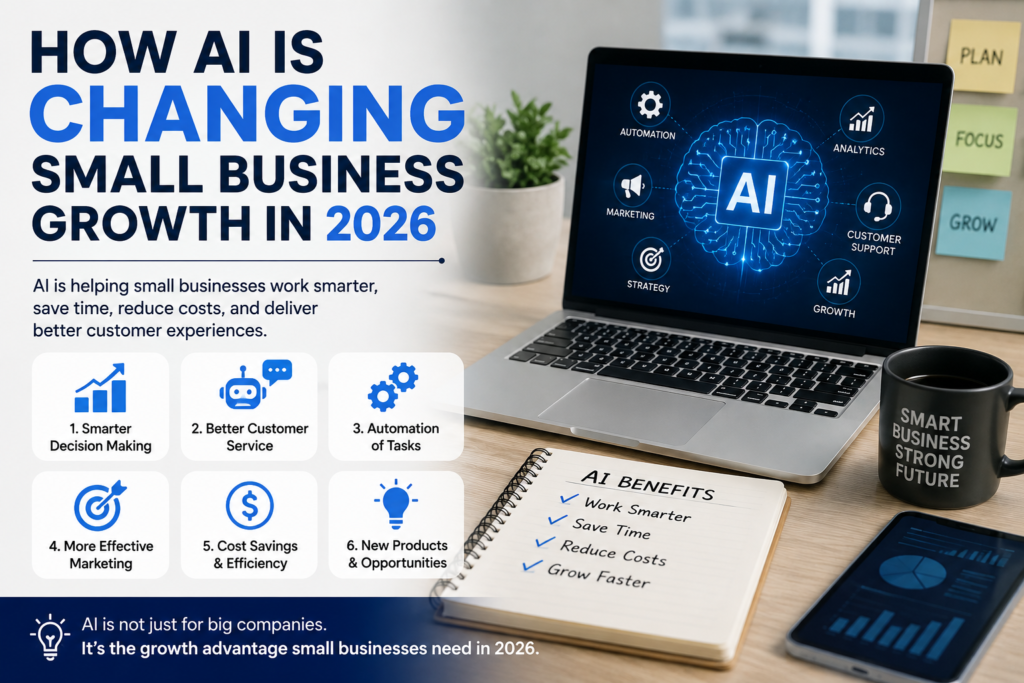
Artificial intelligence is no longer something only large technology companies can experiment with. In 2026, AI is becoming a practical business tool for marketing, customer service, research, administration, and other everyday tasks.
For small businesses, this shift could be particularly important. A company with a small team can use AI to handle certain repetitive tasks, work with information more efficiently, and spend more time on customers and higher-value work.
Recent U.S. Census Bureau data shows that business AI use was around 17%–20% between December 2025 and May 2026. The data also shows that adoption varies considerably by company size and industry.
So, how exactly is AI changing small business growth in 2026?
AI Is Helping Small Businesses Do More With Less
One of the biggest advantages of AI is its ability to support tasks that traditionally require significant amounts of time.
A small business owner might spend hours researching a topic, drafting emails, organizing information, creating marketing material, or preparing basic reports.
AI can assist with parts of these processes.
This does not mean AI replaces the person doing the work. Instead, it can act as a productivity tool that helps the business owner get through routine work more efficiently.
For a small company, saving several hours each week can make a meaningful difference.
1. AI Is Changing Small Business Marketing
Marketing is one of the areas where businesses are already using AI extensively.
According to recent Census Bureau research, among businesses using AI, sales and marketing was the most common business function, followed by strategy and business development and IT.
Small businesses can use AI to help with:
- Content ideas
- Marketing research
- Email drafts
- Social media planning
- Product descriptions
- Customer segmentation
- Advertising concepts
- Website content
The important point is that AI should support the marketing strategy rather than become the strategy itself.
A generic AI-generated article is unlikely to give a business a strong competitive advantage. Content becomes more valuable when it includes real experience, useful information, original examples, and a clear understanding of the target customer.
2. AI Can Improve Customer Service
Customer expectations are changing.
People want quick answers to basic questions, especially when they are looking for information about products, services, orders, or appointments.
AI can help businesses handle some routine customer-service tasks.
For example, an AI-supported system could help answer common questions or direct customers toward relevant information.
This can allow employees to spend more time handling complicated requests that require human judgment.
However, businesses should be careful not to make every customer interaction feel automated. Some situations require empathy, context, and a real person.
3. AI Is Making Business Research Faster
Research is another area where AI can provide useful support.
A business owner might need to understand:
- A new market
- Customer preferences
- Competitors
- Industry developments
- Potential products
- Common customer questions
AI can help organize and summarize information, identify patterns, and generate questions for further research.
But there is an important rule: AI-generated information should be checked before it is used for important business decisions.
AI can produce incorrect or outdated information, so reliable sources still matter.
4. AI Can Help Small Businesses Compete
Large companies often have more employees, bigger budgets, and specialized departments.
Small businesses usually have fewer resources.
AI can help narrow part of that gap by giving smaller teams access to tools that support activities such as writing, research, analysis, marketing, and customer communication.
The U.S. Census Bureau has previously noted that generative AI could potentially help small firms perform tasks that might otherwise require additional specialized workers or outsourcing.
This does not mean AI makes small businesses equal to large corporations.
But it can give a small team more capacity.
5. AI Is Changing How Businesses Think About Productivity
Traditionally, increasing business output often meant hiring more people, buying more equipment, or spending more hours on a task.
AI introduces another possibility: improving the way existing employees work.
For example, instead of spending an hour preparing a first draft of a routine document, an employee might use AI to create an initial version and then spend time reviewing and improving it.
The human still plays an important role.
The goal is not simply to produce more work. It is to spend more time on work that actually matters.
6. AI Is Creating New Business Opportunities
AI is not only changing existing businesses. It is also creating opportunities for new ones.
Entrepreneurs can build businesses around helping companies:
- Implement AI tools
- Automate workflows
- Train employees
- Improve digital processes
- Analyze information
- Create AI-supported services
- Integrate AI into existing operations
This creates an interesting opportunity for people who understand both technology and a particular industry.
The strongest AI businesses may not necessarily be the ones building the most advanced AI models. Some may simply help businesses apply existing technology to practical problems.
7. AI Is Making Business Automation More Accessible
Automation used to be associated mainly with large companies with specialized technical teams.
That is changing.
Small businesses can increasingly use software and AI to automate parts of repetitive workflows.
For example, a business could potentially automate parts of:
Customer inquiry → information collection → follow-up → reporting
The exact process depends on the business, but the principle is simple: identify repetitive work and determine whether technology can handle part of it.
The U.S. Small Business Administration has highlighted applications such as operations, customer service, marketing automation, and inventory management as areas where small businesses can explore AI.
8. AI Is Changing the Skills Small Businesses Need
AI adoption does not simply mean businesses need more technology.
They also need people who know how to use technology responsibly.
Important skills increasingly include:
- Critical thinking
- Research
- Data interpretation
- AI literacy
- Communication
- Problem-solving
- Quality control
An employee who knows how to evaluate AI output may be more valuable than someone who simply knows how to generate it.
That distinction will become increasingly important as AI tools become easier to use.
9. AI Does Not Automatically Guarantee Business Growth
It is easy to assume that adopting AI will automatically make a business more profitable.
That is not necessarily true.
AI is a tool.
If a business has a poor product, unclear positioning, weak customer service, or an ineffective strategy, adding AI will not magically solve those problems.
Successful AI adoption usually starts with a specific business problem.
Instead of asking:
“Where can we use AI?”
A better question is:
“What is taking too much time or creating unnecessary costs, and can AI help us improve it?”
That approach keeps the technology connected to a real business objective.
10. Human Expertise Still Matters
One of the biggest misconceptions about AI is that businesses can simply hand over important work to a tool and walk away.
In reality, human oversight remains important.
AI-generated content may need editing. Research may need verification. Business recommendations may need professional judgment.
Census Bureau research from 2026 found that most AI-using firms were using AI to augment tasks, rather than fully replace human work.
That suggests an important direction for small businesses: AI and people working together rather than treating them as opposites.
How Small Businesses Can Approach AI in 2026
A small business does not need to adopt every new AI tool.
A better approach is to start with one practical problem.
Step 1: Identify repetitive work
Look for tasks that consume time every week.
Step 2: Choose one area to test
Marketing, research, customer service, or administration can be potential starting points.
Step 3: Keep a human involved
Review important outputs and make sure they meet the company’s standards.
Step 4: Measure the results
Ask whether the AI-assisted process actually saves time, improves quality, reduces costs, or helps customers.
Step 5: Expand carefully
If the experiment works, consider applying the same approach to another business process.
This is generally more useful than adopting AI simply because competitors are talking about it.
The Future of AI and Small Business Growth
AI adoption is still developing.
Recent Census Bureau data suggests that businesses continue to experiment with AI, but adoption remains uneven across company sizes and industries. In data covering December 2025 through May 2026, fewer than 20% of firms with four or fewer employees reported using AI, while adoption was substantially higher among larger firms.
That means there is still a large opportunity for businesses to figure out where AI genuinely adds value.
The future may not belong to businesses that use the most AI.
It may belong to businesses that use the right technology in the right places.
Conclusion
AI is changing small business growth in 2026 by giving smaller teams new ways to improve productivity, marketing, customer service, research, and business operations.
But AI should not be viewed as a shortcut to success.
A successful business still needs a useful product or service, loyal customers, good decision-making, and a clear strategy.
The real advantage comes when a business combines those fundamentals with technology that helps people work better.
For small businesses, the question is no longer simply whether AI matters.
The more useful question is:
“Where can AI help us serve customers better and build a stronger business?”
That is where the real opportunity lies.
SEO Information
Focus keyword: AI for small business
Secondary keyword: AI and small business growth
SEO title: How AI Is Changing Small Business Growth in 2026
Suggested URL: /ai-small-business-growth-2026/
Meta description: Discover how AI is changing small business growth in 2026, from marketing and customer service to automation, productivity, research, and new opportunities.
Suggested category: Business
Suggested internal links:
- 10 Small Business Ideas That Could Grow Fast in 2026
- The Rise of the One-Person Business: How AI Is Changing Entrepreneurship
- What If Your Next Competitor Is One Person With AI?
How AI Is Changing Small Business Growth in 2026
In Part 1, we explored how AI is helping small businesses improve marketing, customer service, research, productivity, and automation.
But the impact of AI goes further. It is also changing how businesses make decisions, develop products, manage employees, and compete in increasingly digital markets.
For small businesses, this creates an important opportunity: using AI to become more efficient without losing the human side of the business.
11. AI Is Helping Businesses Understand Their Customers
Understanding customers has always been important, but small businesses often lack the resources to analyze large amounts of customer information.
AI can help organize information from sources such as customer feedback, reviews, surveys, website activity, and sales records.
For example, a business might discover that customers repeatedly mention the same problem in reviews.
Instead of manually reading hundreds of comments, AI can help identify common themes and summarize them.
This can help business owners answer questions such as:
- What do customers like most?
- What problems do they experience?
- Why do some customers leave?
- Which products receive the most attention?
- What questions do customers ask repeatedly?
The final decisions should still come from people who understand the business and its customers.
12. AI Is Changing Business Decision-Making
Business decisions are often based on information from multiple sources.
Sales numbers, customer feedback, market conditions, operating costs, and marketing results can all influence a decision.
AI can help businesses organize and analyze this information more quickly.
For a small company, this can make data more useful.
Instead of looking at a spreadsheet and trying to identify patterns manually, an owner could use AI-assisted analysis to explore trends and ask follow-up questions.
However, business owners should not blindly trust AI recommendations.
AI can make mistakes, misunderstand information, or produce conclusions based on incomplete data.
The best approach is to use AI as a decision-support tool, not as the final decision-maker.
13. AI Is Making Personalization Easier
Customers increasingly expect businesses to understand their needs.
Large companies have traditionally had an advantage because they can invest heavily in customer data and personalization.
AI is making some forms of personalization more accessible to smaller companies.
For example, businesses can use AI-assisted tools to help create different messages for different customer groups.
An online store might communicate differently with:
- New customers
- Returning customers
- Customers interested in different products
- Customers who have not purchased recently
The goal is not to send customers endless automated messages.
Good personalization should make communication more relevant, not simply more frequent.
14. AI Can Help Small Businesses Create Better Content
Content marketing can be difficult for a small team.
A business may know that it needs blog posts, newsletters, social media updates, videos, or product information, but producing everything consistently takes time.
AI can help with parts of the content process.
For example, it can assist with:
- Brainstorming topics
- Creating outlines
- Summarizing research
- Generating draft ideas
- Improving clarity
- Repurposing existing content
But businesses should avoid publishing unedited AI-generated material simply because it is fast.
People still want useful, accurate, original information.
The strongest content combines AI-assisted efficiency with human experience, expertise, editing, and fact-checking.
15. AI Is Changing How Small Businesses Compete
Competition is no longer limited to businesses located nearby.
A small company can compete with businesses in other cities or even other countries through websites, social media, online marketplaces, and digital services.
AI can help small teams manage some of the additional work that comes with competing in a larger market.
For example, a small business can use AI-assisted tools to support research, customer communication, marketing, and internal processes.
This does not eliminate competition.
Instead, it gives entrepreneurs another tool for building a more efficient operation.
16. AI Is Helping Entrepreneurs Build Leaner Businesses
One of the most interesting effects of AI is the possibility of running certain businesses with very small teams.
An entrepreneur may be able to use software to handle parts of administration, research, content creation, customer communication, and other repetitive tasks.
This can make it possible to focus limited human resources on areas where people add the most value.
However, “lean” should not mean “do everything automatically.”
A lean business should have efficient systems, clear priorities, and enough human oversight to maintain quality.
17. AI Is Creating New Roles for Small Businesses
AI is not only removing repetitive tasks. It is also creating new types of work.
Businesses may increasingly need people who can:
- Implement AI systems
- Train employees
- Check AI-generated information
- Manage automated workflows
- Create AI-assisted content
- Analyze AI-supported business data
- Develop company AI policies
This creates opportunities for entrepreneurs who understand both business problems and modern technology.
Someone who understands a particular industry can have an advantage because they know where AI can actually provide value.
18. AI Is Changing E-Commerce
Online stores can use AI in many parts of the customer journey.
For example, AI can assist with product descriptions, customer questions, product recommendations, marketing content, and inventory analysis.
Imagine a small online store with hundreds of products.
Creating and updating product information manually can take considerable time.
AI-assisted tools can help speed up parts of that process while employees review the final results.
The goal is to make the store easier to manage without sacrificing accuracy or customer trust.
19. AI Is Helping With Competitive Research
Understanding competitors can help a business identify gaps in the market.
AI can assist entrepreneurs in organizing publicly available information about competitors, such as:
- Products and services
- Pricing information
- Marketing messages
- Customer reviews
- Website content
- Frequently mentioned strengths and weaknesses
This can help a business identify opportunities to differentiate itself.
However, competitive research should use information obtained legitimately and responsibly. AI should not be used to obtain confidential information or invade competitors’ privacy.
20. AI Is Changing the Cost of Starting a Business
Starting a business traditionally required spending money on many different services.
Depending on the business, entrepreneurs might need help with writing, design, research, administration, customer communication, or marketing.
AI-assisted tools can reduce the time required for some of these activities.
This can lower certain operating costs and make experimentation easier.
But lower costs do not mean that every AI-powered business will succeed.
The fundamental questions remain:
Is there demand?
Does the product solve a real problem?
Will customers pay for it?
Those questions are more important than the technology itself.
What Small Businesses Should Be Careful About
AI creates opportunities, but it also creates risks.
Accuracy
AI can produce incorrect information. Important information should be checked before publication or use.
Privacy
Businesses should be careful about entering confidential customer, employee, or company information into AI systems.
Security
AI tools should be evaluated carefully, particularly when they connect to business systems or sensitive data.
Over-Automation
Automating every customer interaction can make a business feel impersonal.
Quality
Producing more content or completing tasks faster does not necessarily mean the work is better.
These issues are especially important for small businesses because trust can be one of their strongest competitive advantages.
How to Build an AI Strategy for a Small Business
A small business does not need a complicated AI strategy.
Start with a simple process.
Identify the biggest time-consuming tasks
Look for repetitive work that happens regularly.
Find the bottleneck
Determine which task is slowing down the business.
Test one AI-supported solution
Do not try to change everything at once.
Keep human oversight
Review important outputs and monitor quality.
Measure the result
Look at time saved, costs, customer satisfaction, or productivity.
Expand what works
If the first experiment produces useful results, gradually apply AI to other areas.
This approach reduces unnecessary spending and helps businesses learn what actually works for them.
AI and the Future of Small Business Growth
The role of AI in small businesses will likely continue to evolve.
Today’s tools may become more capable, easier to use, and more deeply integrated into everyday business software.
That could change how entrepreneurs think about staffing, operations, marketing, and customer service.
But technology will not remove the need for good business fundamentals.
A company still needs:
- A real customer
- A useful product or service
- A clear value proposition
- Reliable operations
- Strong customer relationships
- Responsible decision-making
AI can strengthen these areas, but it cannot replace them.
Final Thoughts
AI is changing small business growth in 2026 by making certain technologies and capabilities more accessible to smaller teams.
Businesses can use AI to save time, understand customers, improve content, support decision-making, automate repetitive work, and explore new opportunities.
But the biggest advantage may come from something simpler: knowing where not to use AI.
Not every task should be automated.
Not every customer wants to interact with a machine.
And not every business problem can be solved with technology.
The businesses that benefit most may be those that combine AI efficiency with human judgment.
In 2026, the competitive advantage is not simply having access to AI.
It is knowing how to use it responsibly, strategically, and purposefully.
SEO Information
Focus keyword: AI for small business
Secondary keywords: AI and small business growth, AI tools for small business, AI business automation, artificial intelligence for small businesses
Suggested H2: How AI Is Helping Small Businesses Grow in 2026
Internal link opportunity: Link this article to your previous article, “10 Small Business Ideas That Could Grow Fast in 2026,” using natural anchor text such as “small business ideas for 2026.”
21. AI Is Helping Small Businesses Improve Their Websites
A website is often the first interaction a potential customer has with a business.
AI can help businesses improve different parts of that experience, including content planning, customer questions, product information, and website personalization.
For example, a small business could use AI-assisted tools to identify frequently asked customer questions and turn them into useful FAQ content.
AI can also help business owners identify areas where website visitors may need clearer information.
However, the website still needs to feel trustworthy and human.
A website filled with generic AI-generated text may save time, but it may not convince visitors to become customers.
22. AI Is Changing Product Development
Developing a new product usually involves research, testing, customer feedback, and continuous improvement.
AI can support parts of this process.
Entrepreneurs can use AI to organize customer feedback, compare ideas, explore potential use cases, and identify common problems.
This can make experimentation faster.
For example, instead of spending months developing a product based only on an assumption, a business can collect customer feedback, analyze it, and use those insights to improve the idea.
The important principle is simple:
AI can help you test ideas faster, but customers should ultimately determine whether an idea is valuable.
23. AI Can Help Small Businesses Improve Their Pricing
Pricing is one of the most difficult decisions for many entrepreneurs.
Set the price too high, and customers may look elsewhere.
Set it too low, and the business may struggle to cover its costs.
AI-assisted analysis can help businesses examine information such as sales patterns, customer segments, competitor pricing, and historical performance.
This can provide useful information when reviewing pricing decisions.
However, pricing should never be based entirely on an automated recommendation.
Business owners still need to consider costs, positioning, customer expectations, and the value their product provides.
24. AI Is Supporting Employee Training
Training new employees can take considerable time, especially for small businesses without dedicated training departments.
AI can help create training materials, answer basic questions, summarize company information, and support learning activities.
For example, a company could create an internal knowledge system that helps employees find information about company procedures.
This can make onboarding easier.
But employees should still have access to real people when they need clarification or when a situation requires judgment.
25. AI Is Helping Entrepreneurs Save Time on Administration
Administrative work may not generate revenue directly, but it can consume a large amount of an entrepreneur’s day.
AI-supported tools can assist with tasks such as:
- Organizing information
- Drafting routine communications
- Summarizing meetings
- Preparing documents
- Scheduling
- Creating reports
- Managing repetitive workflows
For a small business owner, the value may come from getting several hours back each week.
Those hours can then be spent on customers, product development, partnerships, or strategic planning.
26. AI Is Creating More Opportunities for Niche Businesses
One interesting effect of AI is that smaller businesses can become more specialized.
In the past, a small company might have needed a larger team to serve a narrow market profitably.
AI can reduce the amount of repetitive work involved in operating certain specialized businesses.
This creates opportunities for entrepreneurs to focus on smaller audiences with specific needs.
For example, instead of creating a general marketing company, an entrepreneur could specialize in marketing for a particular industry.
Specialization can make it easier to understand customers and develop a strong reputation.
27. AI Is Changing How Businesses Build Trust
As AI-generated content becomes more common, customers may become more interested in knowing whether the information they see is accurate and trustworthy.
This creates an interesting opportunity for small businesses.
Businesses can differentiate themselves through:
- Original research
- Real customer experiences
- Transparent communication
- Expert opinions
- Accurate information
- Clear sources
- Human customer support
In an environment where anyone can generate large amounts of content, credibility becomes more valuable.
The goal should not be to hide the use of technology.
The goal should be to make sure technology supports high-quality work.
28. AI Can Help Small Businesses Expand Into New Markets
Expanding into another market can require research, localization, customer support, and new marketing material.
AI can assist with some of these tasks.
For example, businesses can use AI-supported tools to help research new markets, translate draft content, analyze customer questions, and prepare initial marketing ideas.
Human review remains essential, particularly when language and cultural differences matter.
A direct translation may be grammatically correct but still fail to communicate naturally with a local audience.
29. AI Is Changing the Competitive Advantage
For years, businesses competed through factors such as price, location, product quality, service, and brand reputation.
AI is adding another factor: operational efficiency.
A company that can respond faster, research faster, produce useful content faster, and organize information more efficiently may have an advantage.
But efficiency alone is not enough.
If every competitor has access to similar AI tools, the technology itself becomes less distinctive.
The competitive advantage comes from how the business applies the technology.
That could mean better processes, stronger customer relationships, better industry knowledge, or a more valuable product.
30. AI Is Encouraging Businesses to Think Differently About Growth
Traditionally, business growth often meant hiring more employees, opening more locations, or increasing physical capacity.
AI introduces another approach.
A business may be able to increase its output by improving its systems and workflows.
This does not mean businesses should avoid hiring people.
Instead, it means entrepreneurs can think more carefully about which activities require additional employees and which activities can be improved through technology.
That can lead to more flexible business models.

What Should Small Businesses Do Next?
If your business has not started using AI yet, there is no need to panic.
You do not need to adopt every new tool.
Start by identifying one problem.
Maybe your team spends too much time writing repetitive emails.
Maybe customer questions are taking too long to answer.
Maybe employees spend hours organizing information.
Maybe marketing content takes too long to produce.
Choose one problem and test whether AI can help.
Then measure the result.
Did it save time?
Did quality improve?
Did customers have a better experience?
Did employees find the process easier?
If the answer is yes, you have a reason to continue.
Three Mistakes Small Businesses Should Avoid
1. Using AI simply because everyone else is
Technology should solve a problem. It should not be adopted just because it is popular.
2. Publishing everything AI generates
AI output should be reviewed, edited, and fact-checked before being used for important business purposes.
3. Forgetting the customer
A business can become so focused on automation that it forgets why the business exists in the first place.
Customers want useful products, reliable service, and clear communication.
AI should support those things—not replace them unnecessarily.
The Bigger Picture
The biggest change AI brings to small business may not be a particular tool.
It is a change in how entrepreneurs think about time, resources, and scale.
A small team can increasingly access technologies that were once available mainly to larger organizations.
That creates opportunities for entrepreneurs who are willing to experiment and learn.
But technology alone does not create a successful company.
A business still needs people who understand the market, listen to customers, make good decisions, and take responsibility for the outcome.
Final Thoughts
AI is changing small business growth in 2026 in ways that go beyond automation.
It is influencing marketing, product development, pricing, employee training, customer experience, administration, and even how entrepreneurs think about competition.
For some businesses, AI may help reduce repetitive work.
For others, it may create entirely new products and services.
The most important lesson is that there is no single way to use AI.
Every business has different customers, challenges, and goals.
The businesses that benefit most will likely be those that experiment carefully, measure results, protect customer trust, and combine technology with human judgment.
AI can make a small business more capable—but the entrepreneur still decides where that capability should be used.
And as AI becomes more common, that human decision-making may become one of the most valuable advantages a business can have.
SEO Details
Focus keyword: AI for small business
Secondary keywords:
- AI and small business growth
- AI tools for small businesses
- artificial intelligence for business
- AI business automation
- small business AI strategy
- AI productivity for small business
Suggested SEO title:
How AI Is Changing Small Business Growth in 2026
Suggested URL:/ai-small-business-growth-2026/
Meta description:
Discover how AI is changing small business growth in 2026, from automation and marketing to customer experience, product development, productivity, and business strategy.
Suggested category: Business
31. AI Is Helping Businesses Create Better Business Plans
Creating a business plan can be difficult, particularly for first-time entrepreneurs.
AI can help organize ideas, identify important questions, structure research, and create an initial framework for a business plan.
For example, an entrepreneur can use AI to explore:
- Target customers
- Competitors
- Potential revenue models
- Marketing channels
- Operating costs
- Business risks
However, AI should not invent the facts behind the plan.
A strong business plan should be based on real market research, realistic financial assumptions, and genuine knowledge of the target customer.
AI can help structure the thinking, but the entrepreneur must provide the judgment.
32. AI Is Making Market Research More Accessible
Large corporations can spend significant amounts of money researching markets.
Small businesses usually cannot.
AI can make some parts of market research faster and more accessible by helping entrepreneurs organize publicly available information.
For example, a business owner could use AI to help compare competitors, categorize customer reviews, identify common complaints, or summarize industry developments.
This can help entrepreneurs spot opportunities they might otherwise miss.
But AI should be treated as a starting point.
Before making an important investment, businesses should verify important findings with reliable sources and, when possible, direct customer research.
33. AI Can Help Businesses Improve Their Sales Process
Sales teams spend considerable time researching prospects, preparing messages, updating records, and following up with potential customers.
AI can assist with parts of these processes.
For example, it can help sales teams:
- Organize prospect information
- Draft follow-up messages
- Summarize customer conversations
- Identify potential questions
- Prepare meeting notes
- Prioritize routine tasks
The goal is not to turn sales into a completely automated process.
People still need to understand customer needs and build relationships.
AI can simply reduce some of the administrative work surrounding the sales process.
34. AI Is Helping Small Businesses Analyze Reviews
Customer reviews contain valuable information.
A business may receive hundreds of reviews across different platforms, making it difficult to identify every recurring issue manually.
AI can help categorize feedback into themes such as:
- Product quality
- Delivery
- Customer service
- Pricing
- Website experience
- Product features
This can give business owners a clearer picture of what customers are actually experiencing.
More importantly, businesses can use those insights to improve.
A negative review is not always just a problem. It can also reveal an opportunity to fix something that affects many customers.
35. AI Is Supporting Inventory Management
For businesses that sell physical products, inventory can be complicated.
Having too much stock can tie up money, while having too little can lead to missed sales.
AI-assisted systems can help businesses analyze sales patterns and identify potential changes in demand.
For example, a retailer could examine historical sales information to better understand which products move quickly and which products remain on shelves longer.
AI does not eliminate uncertainty, but better analysis can help businesses make more informed inventory decisions.
36. AI Is Changing How Businesses Handle Internal Knowledge
As a business grows, information becomes scattered across emails, documents, spreadsheets, websites, and internal systems.
Employees may waste time searching for basic information.
AI-powered knowledge systems can help employees find relevant company information more quickly.
For example, employees might be able to search for:
“What is our return policy?”
or
“How do we handle this type of customer request?”
Instead of searching through multiple documents, an AI-supported system can help locate the relevant information.
Businesses still need to control access and protect confidential information, but better knowledge management can make teams more efficient.
37. AI Is Creating Opportunities for Micro-Businesses
One of the most interesting effects of AI is its potential to help very small businesses operate with greater efficiency.
A single entrepreneur may be able to handle activities that previously required several separate services.
For example, one person might use software to assist with:
- Research
- Content creation
- Customer communication
- Scheduling
- Basic administration
- Marketing
This does not mean one person can do everything perfectly.
It means technology can reduce some of the repetitive work that previously consumed valuable time.
This could encourage more entrepreneurs to experiment with specialized businesses and small digital services.
38. AI Is Changing How Small Businesses Approach Customer Retention
Getting a new customer is often only the beginning.
Businesses also need to give customers reasons to return.
AI can help businesses analyze customer behavior and identify patterns that may indicate when customers are becoming less engaged.
For example, a business could use customer data to understand:
- How frequently customers purchase
- Which products they prefer
- When customers typically return
- Which offers receive attention
- What causes customers to stop engaging
The goal should be better customer service, not simply sending more promotional messages.
Good retention strategies should provide genuine value.
39. AI Is Helping Businesses Experiment Faster
Traditional business development can be slow.
An entrepreneur may have an idea but spend weeks creating content, researching the market, preparing a proposal, or testing different approaches.
AI can speed up some of these early experiments.
For example, a business can quickly create different versions of:
- Marketing messages
- Product descriptions
- Customer surveys
- Landing-page ideas
- Business proposals
- Content concepts
The business can then compare the results and learn what customers respond to.
This creates a useful cycle:
Idea → Test → Measure → Learn → Improve
The faster a business can learn without sacrificing quality, the easier it may become to adapt.
40. AI Is Making Adaptability More Important
Perhaps the biggest lesson for small businesses is that the technology landscape is changing quickly.
A tool that is considered advanced today may become a standard feature inside ordinary business software tomorrow.
That means businesses should avoid building their entire strategy around one particular AI tool.
Instead, focus on developing a culture of learning.
Businesses that can:
- Test new technologies
- Measure results
- Train employees
- Protect customer information
- Adapt their workflows
- Replace tools when necessary
may be better prepared for future changes.
The real competitive advantage is not necessarily knowing every new AI product.
It is knowing how to adapt when technology changes.
What Will Separate Successful AI Users From Everyone Else?
As AI becomes more common, simply saying that a business “uses AI” will not be impressive.
Many businesses will have access to similar tools.
The difference will come from how those tools are used.
A company might use AI to create hundreds of pieces of content.
Another company might use AI to create fewer pieces of content but combine them with original research, customer insights, expert knowledge, and strong editing.
The second approach may create more value.
This is why AI for small business should be viewed as a capability rather than a complete strategy.
AI Should Support the Business, Not Become the Business
There is a temptation to automate everything.
But not every task should be automated.
A customer with a complicated problem may want to speak with a real person.
An important business decision may require human judgment.
A creative project may need personal experience and original thinking.
And sensitive information may require additional security precautions.
The smartest businesses will learn where AI is useful and where human involvement remains essential.
A Practical AI Checklist for Small Businesses
If you are considering introducing AI into your business, start with these questions:
1. What takes the most time?
Identify repetitive tasks that happen regularly.
2. What creates the most frustration?
Employees often know which processes are inefficient.
3. Can technology actually improve it?
Not every problem requires AI.
4. What information will the tool access?
Consider privacy and security before connecting AI to business systems.
5. Who will review the results?
Important work should have appropriate human oversight.
6. How will you measure success?
Decide whether you are trying to save time, reduce costs, improve quality, increase sales, or improve customer experience.
7. What happens if the tool makes a mistake?
Create a process for identifying and correcting errors.
This simple checklist can prevent businesses from adopting technology without understanding its purpose.
The Long-Term Opportunity for Small Businesses
The real opportunity behind AI may not be about replacing employees or creating endless automation.
It may be about giving small businesses capabilities that were previously expensive or difficult to access.
A small company can increasingly use technology to support research, marketing, customer service, administration, analysis, and operations.
That can give entrepreneurs more time to focus on the things technology cannot easily replace:
understanding people, building relationships, solving problems, and making decisions.
Final Thoughts
AI for small business is becoming an important part of the business landscape in 2026.
From marketing and sales to customer support, market research, inventory, internal knowledge, and business planning, AI can help small companies work more efficiently and experiment more quickly.
But technology should never become the main objective.
The objective is still to build a business that customers value.
AI can help you save time.
It can help you analyze information.
It can help you create and test ideas.
It can help a small team accomplish more.
But customers still decide whether a business succeeds.
The entrepreneurs who understand this distinction may have the strongest advantage: they will use AI not simply because it is available, but because it helps them solve real problems better.
As AI continues to evolve, small businesses do not need to predict exactly what the future will look like.
They need to become good at learning, testing, adapting, and using technology responsibly.
That may be the most important lesson of AI and small business growth in 2026.
SEO Details
Focus keyword: AI for small business
Secondary keywords:
- AI and small business growth
- AI tools for small business
- AI for small businesses
- artificial intelligence for business
- small business AI strategy
- AI business automation
- AI productivity for small business
SEO title:
How AI Is Changing Small Business Growth in 2026
Suggested URL:/ai-small-business-growth-2026/
Meta description:
Learn how AI for small business is changing growth in 2026, from sales and marketing to customer retention, market research, automation, and productivity.
Suggested category: Business